





Written by
Aviv Herzlich
Israeli Tour Guide
When Brothers Became Enemies: The Bible’s Hope for a United Israel
The story of Israel and Judah is more than a tale of political division. It is a story of a people struggling to reunite, and of prophets who never abandoned that hope.
What if the division of the ancient kingdom of Israel was never meant to be the final chapter of the story?
After Solomon’s reign, the united monarchy split in two. The northern tribes formed the Kingdom of Israel, while Judah, centered on Jerusalem, remained under the house of David. Yet the biblical narrative repeatedly returns to the possibility that the two kingdoms might one day become one people again.

Biblical Shiloh, located in the hill country of Samaria about 26 miles (42 km) north of Jerusalem
The prophet Ahijah of Shiloh offers a remarkable starting point. When he announces the division, he delivers a promise concerning David’s descendants:
“I will humble David’s descendants, but not forever” (1 Kings 11:39).
Yet Jeroboam, the first king of the northern kingdom, seems determined to make the separation permanent. He establishes new worship centers at Bethel and Dan, appoints his own priests, and introduces a different religious calendar (1 Kings 12:26-33). A political division becomes a religious one as well.
Jeroboam's Altar in Tel Dan, Israel

A Shared Faith Beyond Political Borders
And yet, the biblical story reminds us that these are still one people.
In 1 Kings 13, a man of God from Judah encounters an older prophet in Bethel. Despite the divisions between their kingdoms, they sit down to eat together. Their encounter ends tragically, but it offers a striking image: even when kings divide the land, people who share a faith and heritage can still recognize one another.
A more concrete hope emerges during the reign of King Asa of Judah. According to 2 Chronicles 15, people from the northern tribes migrate to Judah, and people from both kingdoms gather in Jerusalem to renew their covenant with God. Could this be the beginning of a reunion?
But Baasha, king of Israel, builds up Ramah to prevent people from crossing into Judah. Asa responds by appealing to Ben-Hadad, king of Aram, to attack Israel. The Arameans strike northern towns, including Ijon and Dan (1 Kings 15:16-22).
Once again, the hope of reconciliation gives way to rivalry, and a foreign power is drawn into an internal conflict.
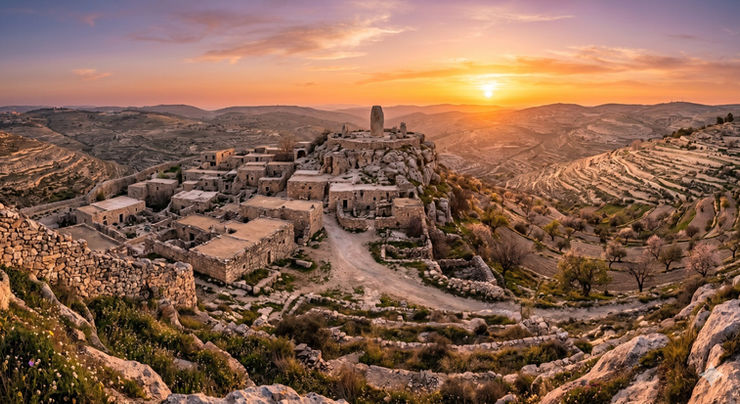
A scaled image of ancient Bethel in ancient Samaria, West Bank
Jeroboam II and Uzziah: A Second Chance?
More than a century later, another opportunity seems to emerge.
Under Jeroboam II in Israel and Uzziah in Judah, both kingdoms experience territorial expansion and renewed prosperity. Politically, they remain separate, but the prophets continue to speak of them as parts of one people.
Amos, a prophet from Judah, delivers his message concerning Israel during the reigns of both kings (Amos 1:1). Hosea, prophesying primarily to the northern kingdom, looks toward a future beyond the division: “In that day the people of Judah and the people of Israel will come together; they will appoint one leader” (Hosea 1:11).
For a moment, the prosperity of both kingdoms seems to offer something more than military and economic success. Though divided on the map, Israel and Judah remain connected in the prophetic imagination, sharing a common past and destiny.
But the opportunity passes. In 722/721 BCE, Assyria conquers Samaria, bringing the northern kingdom to an end.
The Prophets Never Abandoned Hope
The destruction of Israel did not erase the vision of reunion.
Jeremiah, prophesying in Judah, imagines a future in which the northern tribes return and once again look toward Jerusalem:
“Come, let us go up to Zion, to the LORD our God” (Jeremiah 31:6).
Ezekiel makes the vision even more explicit, describing two sticks, representing Judah and Joseph, becoming one in God's hand (Ezekiel 37:15-28).
Again and again, the prophets imagine a future in which the divisions of the past will be healed.
An Ancient Story with a Modern Echo
For Israelis today, this ancient story has a painful contemporary resonance.
In 2023, Israel was deeply divided over the government's proposed judicial overhaul. On Yom Kippur, confrontations between Jewish Israelis in Tel Aviv exposed the depth of the national rift.
Just over a week later, on October 7, Hamas launched its devastating attack on Israel, beginning a period of war, loss, and national trauma.
These events do not mean that internal division causes national catastrophe. But they remind us how fragile a shared sense of destiny can become. The biblical prophets understood that a people needs more than political power: it needs a shared moral vision and a sense of responsibility for one another.
A Hope That Endures
The story of the divided kingdom is ultimately not just a story of failure. It is also a story of hope. Even when Israel and Judah remained separate, the prophets continued to imagine them as one people. Jeremiah captured that hope in words that still resonate today:
“I have loved you with an everlasting love; I have drawn you with unfailing kindness” (Jeremiah 31:3).
Jeremiah envisions a renewed Israel, where vineyards flourish on the hills of Samaria, joy returns, and the people of Ephraim invite one another to Jerusalem.
For those visiting the Holy Land, these are more than ancient political stories. They are part of the landscape, the faith, and the continuing conversation about what it means to belong to a people.
The question that confronted the kings of Israel and Judah remains with us today: Can a divided people rediscover what holds it together?
The biblical prophets never stopped believing that the answer could be, Yes!
